
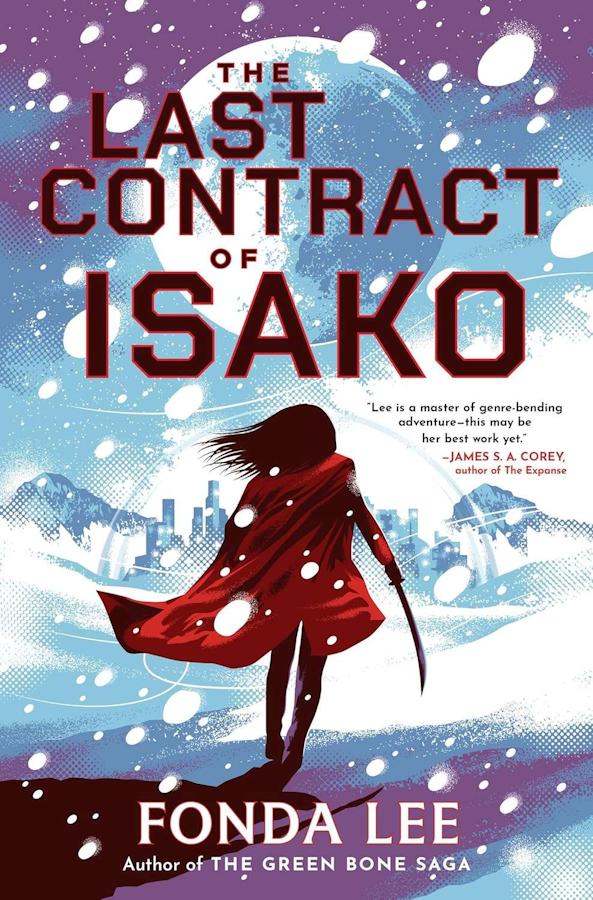
The Last Contract of Isako by Fonda Lee is the tale of a corporate samurai on a space colony fulfilling their last mission before they retire, which on this colony means walking to their own death. Not going to lie, my experience with cyberpunk is limited, but this novel definitely fits the bill with one giant megacorporation ruling over exploited labor where the resources are low, and the stakes are high. It’s filled with action, espionage, and even a murder mystery that takes an unexpected turn.
The book takes the reader to the planet of Aquilo, where humans have left Earth to form their own colony, where everything and everyone revolves around The Company, dedicated to making this cold planet a new home for humanity. Resources are thin, so if you’re not useful and are laid off, you may be forced to resign, which in this setting means a voluntary suicide, walking into the frozen wasteland of the planet to preserve resources needed for everyone else. Isthmus Isako is an Atier, hired contractors who work as highly trained advisors, bodyguards, and samurai-like assassins, who finds herself after the division she was contracted out to work for lost their corporate political war, given one last mission before she can resign and give her daughter a good resignation bonus.
In the acknowledgements, Fonda Lee calls the world of The Last Contract of Isako an inherently cruel one, and I felt that throughout getting an unsettling feeling as details about the Company, Tenacity Cityhab, and the planet Aquilo emerge. The entire human colony is a dystopian company town where people are disposable tools, and what makes it worse is the bits of utopia sprinkled in. As long as you work for the Company, a range of benefits is provided, including healthcare and childcare. However, losing your job can be a death sentence, often literally. Even when you are employed and given access to advanced technology and care, the difference between the wagefolk at the bottom and the directors at the top is stark. The Directors at the top have access to synthbodies, highly advanced android-like bodies that they can put their brains into, extending their life far beyond where the Wagefolk at the bottom will have to retire and resign to save resources. The uncanny valley of the brains in a synthetic body earns them the name Jarheads from those beneath them.
From the moment Isako’s forced into this final contract, she radiates I’m getting too old for this shit but a character who feels she’s ready to do the honorable thing and die at fifty-years-old couldn’t be less relatable as a reader. What makes Isako frustrating as a character early in the book is that, despite what can be clearly seen as frustration with her situation, how bought into the Company and the Agency as if there is no other way. Despite her seeing up close and personal the difficulties of freelance life when she reunites with a friend she lost touch with and former atier Rain Kob, she remains resigned to the Company and Agency ways that will eventually lead to her voluntary death. Further in, seeing Isako’s professionalism falling away to be replaced with anger and need for personal revenge is when the character began to click with me more as a murder mystery reveals itself. In part one’s final chapter, as the tension is ratcheting up with Isako taking decisive action, that is when the twist that was coming dawned on me before it happened. I’ll be interested to see if and when other readers saw this coming earlier or not at all.
Immediately after the book enters part two, trading the sci-fi samurai action for sci-fi corporate espionage, taking the reader back to everything that happened in part one and even before from a different point-of-view. This, to me, is when the book ranks up in quality, and although the cruelty ranks up with it, it goes from wanting to look away to being unable to look away. It goes up close and personal with Director Sandbar Uchi, head of SoCon GasPro, and the conflict between reunionists, who want to move resources to reestablishing contact with the Earth, and terraformist who want to focus resources on terraforming Acquilo, of which Sandbar Uchi is on the side of. I felt a pit in my stomach as I kept turning the pages, as if knowing a tragic event was going to happen, and getting a sense there was another layer of tragedy underneath that never needed to happened but being unable to prevent it.
I underestimated the author because it was so much worse, but I was so sucked in that there was no turning back the pages as the truth about the conflict between the reunionist and the terraformist was revealed. The final act brings it all together, layering the tragedies on top of each other until the climax. The ending of The Last Contract of Isako is a satisfying conclusion but a cruel reality check, as if to say did you really expect this to end any other way? I’m glad to have read it, but it did leave me with a guttural, empty feeling of wanting to turn away from this setting. It doesn’t feel as if anyone is better off. Indeed, some are even worse off, while others merely have their fate delayed. A therapist once told me there is no such thing as negative or positive emotions, but simply emotions. The Last Contract of Isako left me wanting more for the characters involved and the world they live in, without a way for them to achieve that. The fact that these characters made me feel anything at all is a triumph of this book and any book. Despite this, the conclusion was as positive for the cast as it was going to get for the characters that remain, finding some joy in their lives, and sometimes that is more than enough.
Check out No Page Unturned, a book podcast featuring this reviewer on the Geeklyinc network
Joshua was provided an advance copy of the book by Orbit Books.
If you liked this review, please consider buying the reviewer a coffee.
Follow Joshua MacDougall @FourofFiveWits on Bluesky and Twitch.
Check out No Page Unturned’s episode on Fonda Lee’s Jade City